Who Are the Best Thermal POS Paper Manufacturers in China?
Choosing the best Thermal Pos Paper manufacturer in China requires more than comparing prices. A receipt roll may look simple, yet coating consistency, paper thickness, winding, and clean cutting affect daily printer performance. Grand View Research estimated the global thermal paper market at about USD 4.3 billion in 2023 and projected continued growth through 2030. That market context helps explain why buyers face many suppliers—and why careful checks matter.
This guide compares manufacturers through practical criteria: product range, sample quality, customization, production capacity, and export experience. Buyers should also request current technical data sheets and confirm paper width, roll length, core size, and print durability before placing large orders. Ask how suppliers manage coating uniformity and protect rolls from heat, light, and moisture during storage. Small details matter.
A polished website is not proof of consistent production. Nor is a low quotation. Supplier claims should be checked against samples, documented specifications, and clear communication. This comparison cannot replace a factory audit, and report estimates do not identify the best supplier. They do, however, offer a useful starting point for shortlist decisions. The strongest choice is the manufacturer that can show repeatable quality and meet your actual printer and delivery requirements—not merely promise both.
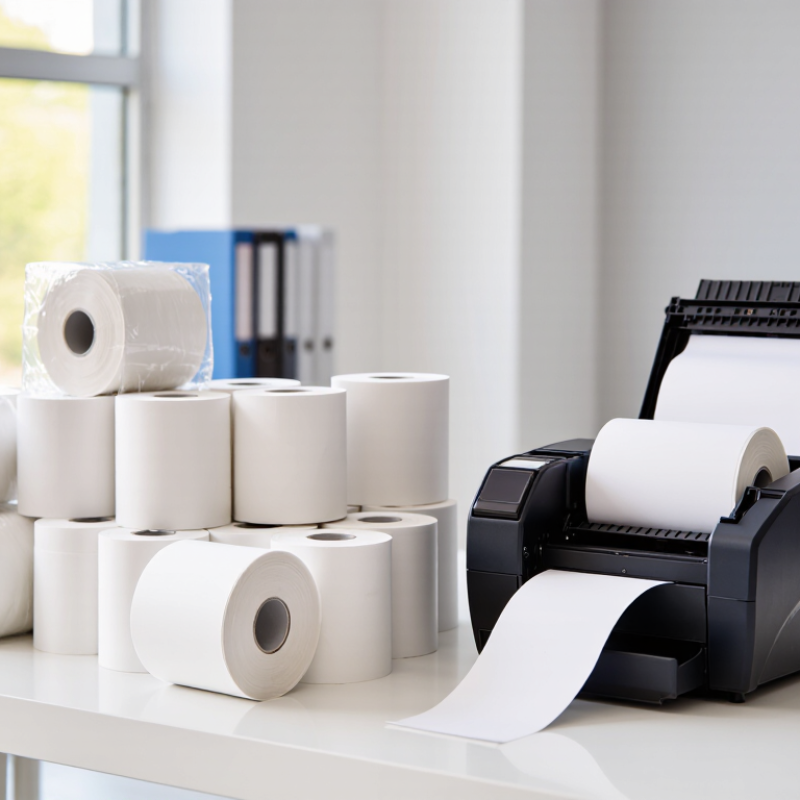
What Thermal POS Paper Is and How It Works
Thermal POS paper is coated paper that prints through heat, not ink or toner. Its surface contains a heat-sensitive layer with color-forming chemicals. A printer’s thermal head presses against the paper and heats tiny points in a chosen pattern. The heated areas darken, forming text, prices, and barcodes. No ink required. The printhead’s temperature, contact pressure, and paper-feed speed all affect clarity.
Inside the coating, heat triggers a reaction between a dye precursor and a developer. The result is a visible mark on the paper’s surface. That is why a receipt can emerge warm, with crisp black characters against a pale background. Direct thermal printing has few moving parts, but it is not foolproof. Uneven coating or a dirty printhead can create faint streaks. Store receipts away from heat and strong light; otherwise, print may fade sooner than expected.
The technology supports a substantial market. Grand View Research’s 2023 Thermal Paper Market Size, Share & Trends Analysis Report estimated global market revenue at about USD 4.31 billion in 2022, with projected annual growth of 6.8% through 2030. This figure describes market demand, not print quality. For POS buyers, paper thickness, coating consistency, and tested compatibility with the printer matter more than a roll’s appearance. One detail is easy to overlook: a readable receipt depends on both the paper coating and the printer settings.
Criteria for Evaluating Thermal POS Paper Manufacturers in China
Who Are the Best Thermal POS Paper Manufacturers in China?
Criteria for Evaluating Thermal POS Paper Manufacturers in China
Choosing a manufacturer takes more than comparing quotations. Grand View Research valued the global thermal paper market at about USD 4.07 billion in 2022 and projected 5.2% annual growth through 2030. That growth makes supplier capacity relevant, but volume alone says little about roll quality. Ask for recent production records, traceable batch numbers, and documented quality controls.
Test samples on your own POS printers. Check print darkness, edge sharpness, paper dust, and feed consistency across several rolls. Then compare results after exposure to heat, humidity, and rubbing. Small details matter. A glossy sample can still hide uneven coating or weak image retention. I would also request measurements for roll width, length, core diameter, and paper weight, plus clear procedures for handling defects.
Review chemical-safety documentation and the supplier’s quality-management system, then verify that certificates match the actual production site. Certificates help, but they do not replace independent test results. Ask how the manufacturer controls coating variation and handles rejected batches. Response time matters too, especially when orders need specification changes. One limitation is that supplier-provided samples may not reflect every production run. Request samples from multiple batches when possible, and record your printer settings during testing.
Who Are the Best Thermal POS Paper Manufacturers in China?
Criteria for Evaluating Thermal POS Paper Manufacturers in China
Suggested evaluation weights for comparing suppliers. The percentages are a practical assessment framework, not measured scores for specific manufacturers. Consider product consistency, coating performance, compliance, and delivery capability when evaluating suppliers.
Profiles of Notable Chinese Thermal POS Paper Manufacturers
Chinese thermal POS paper manufacturers include integrated producers and specialist converters. Integrated facilities may control coating, slitting, and roll packing, which can help maintain consistency. Converter-focused suppliers often offer flexible roll widths and core sizes for different receipt printers. Small details matter.
Among notable suppliers, one profile emphasizes coating uniformity and image clarity. Buyers can request samples and check whether receipts print evenly across the roll. Another profile focuses on converting precision: clean edges, firm winding, and consistent roll length. Export-oriented suppliers may provide specification sheets and shipment records, but documentation quality can differ. A polished sample is not enough. I would also compare batch-to-batch results, since a single test roll may hide variation. Ask for proof.
Tips: Confirm paper width, roll diameter, core size, and paper weight before ordering. Test samples in the intended printer, then inspect print darkness and paper dust. Ask how the supplier tracks production batches. These checks are practical, though they cannot replace ongoing quality reviews.
How Manufacturers Compare in Quality, Capacity, and Service
Comparing thermal POS paper manufacturers in China means looking beyond a bright white sample. Check whether the coating is even, the roll edges are clean, and the paper feeds smoothly through a printer. Print a few receipts and compare the darkness, sharpness, and fading after handling. Small details matter. A loose core or dusty edge can cause trouble at a busy checkout.
Quality should be consistent across batches, not just in one approved roll. Ask how incoming materials and finished rolls are checked, and whether inspection records can be shared. Capacity matters too: confirm monthly output, normal lead times, and how the factory handles a sudden increase in order volume. A large stated capacity is less useful if schedules shift without warning. I sometimes trust a neat sample too quickly; that is a mistake worth guarding against.
Service shows up in practical moments. Can staff confirm roll width, length, core size, and packaging clearly before production? Do they send updates when a shipment is delayed or a specification needs review? Request a trial order and check the delivered rolls against the agreed details. Fast replies help, but accurate replies help more. One small weakness: written answers can sound confident while leaving a measurement unclear, so record the final specifications in plain terms.
How to Choose a Thermal POS Paper Supplier for Your Business
Choosing a thermal POS paper supplier starts with your printer, not a price list. Confirm the roll width, outer diameter, core size, and winding direction your machines require. Ask the supplier to state roll length and paper weight clearly; two rolls can look alike but run very differently at the checkout. Measure a sample. Check that it feeds smoothly and does not leave dust on the printhead.
Paper quality shows up in daily use. Print the same receipt on several samples, then compare text sharpness, darkness, and smudging. Ask how the supplier checks coating consistency between production batches and whether they can provide product specifications and relevant safety documents. Test receipts after exposure to ordinary light and warm storage. Thermal images can fade. That matters for returns and recordkeeping.
Reliability matters as much as a clean sample. Discuss production capacity, minimum order quantities, packaging, delivery schedules, and how defects are handled. Request samples from the actual production line when possible, not just a hand-picked roll. A site visit or a clear factory audit report can help verify manufacturing claims. Compare total landed cost, including freight and damaged rolls, rather than unit price alone. I once underestimated packaging needs; the rolls arrived scuffed. A small test order may feel slow, but it can reveal problems before they reach every register.