


How to Find a Trade Show Booth Rental Alternative in 2026
In 2026, choosing a trade show booth is less about owning impressive walls and more about creating a useful experience. A Trade Show Booth Rental Alternative may suit brands that want greater control over design, repeated use, or storage. Options can include purchasing a modular exhibit, adapting an existing display, or partnering with a fabricator on a reusable system. Each choice carries different costs, setup demands, and risks.
Marlys Arnold, a trade show marketing educator and author, is a relevant expert voice on exhibit planning. However, no source article or verified quotation was provided here, so I won’t attribute invented words to her. That matters. Trust starts with accurate sourcing, not a polished-sounding quote. This guide instead focuses on practical questions exhibitors can check: how often the booth will be used, what shipping and storage require, and whether the design can change between events.
Picture the real work: crates arriving at a convention center, a team assembling a frame, and graphics needing replacement before the next show. A rental may reduce storage burdens, while a reusable alternative may offer more consistency over time. Neither is automatically cheaper. Costs depend on labor, transport, customization, and the number of events. Some comparisons still miss hidden expenses. This guide will help readers assess those trade-offs, ask vendors specific questions, and choose an approach that fits their event schedule, team capacity, and measurable goals.
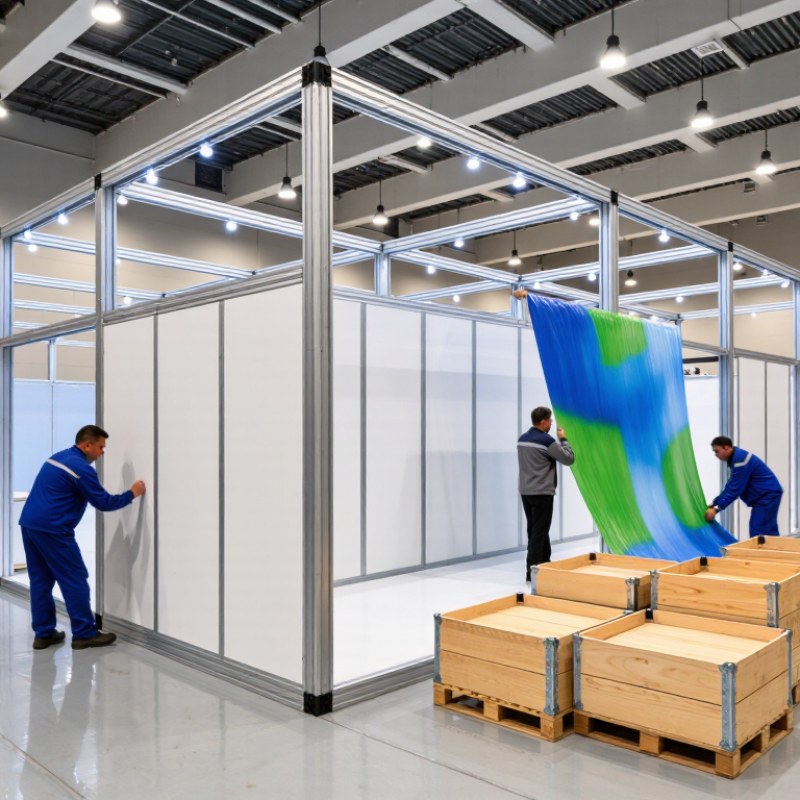
Define Your Trade Show Goals and Booth Requirements
Before comparing booth rental alternatives in 2026, decide what your exhibit needs to achieve. Is the main goal qualified conversations, product demonstrations, or scheduled meetings? Choose one primary outcome and set a measurable target, such as 30 useful conversations per day. Keep the number realistic. A busy aisle can look impressive while producing few worthwhile leads.
Write down the booth footprint, height limits, power needs, internet access, storage, lighting, and setup requirements. Confirm venue specifications rather than relying on last year’s plan. A 10-by-10-foot booth with two demo stations needs room for visitors to stop without blocking the aisle. Count staff, too. Three people behind a narrow counter can make even a well-designed space feel crowded.
Separate essentials from preferences. A paper floor plan can reveal whether a counter, screen, and product display actually fit. It is easy to overbuild. Compare options using the full cost: transport, installation, storage, and updates—not just the display price. Note what could be reused at another event and what must change. Your brief may still miss a detail; mark open questions clearly, then verify them with the venue and event team before committing.
How to Find a Trade Show Booth Rental Alternative in 2026 — Define Your Trade Show Goals and Booth Requirements
| Trade Show Goal | Example Success Measure | Booth Requirements to Define | Rental Alternative to Evaluate | Planning Check |
|---|---|---|---|---|
| Generate qualified leads | Set a target for qualified conversations or completed lead forms per show day. | Open entry, clear product messaging, accessible lead-capture stations, and space for brief conversations. | Reusable modular frames with replaceable graphic panels and rented counters or furniture. | Confirm how leads will be qualified, recorded, and followed up after the event. |
| Demonstrate a product or service | Track scheduled demonstrations, completed demonstrations, and attendee engagement. | Power and internet access where needed, suitable screen placement, safe cable routing, and enough viewing space. | A rented display structure paired with locally sourced or venue-provided audiovisual equipment. | Check venue technical rules, power availability, internet options, and demonstration sound limits. |
| Build brand awareness | Measure booth visits, content interactions, and post-show changes in website or campaign activity. | Visible messaging, consistent graphics, good sightlines, and lighting permitted by the venue. | A standard modular booth with lightweight graphic skins that can be updated for each event. | Keep the main message readable from the aisle and consistent with approved brand guidelines. |
| Meet existing customers or partners | Set a target for scheduled meetings and completed partner discussions. | Seating or a meeting counter, a quieter conversation area, and practical storage for materials. | A smaller exhibit structure supplemented by rented tables, chairs, or a meeting-room booking. | Compare the cost and availability of booth meeting space with nearby venue meeting options. |
| Test a new market or event | Evaluate attendee fit, lead quality, meeting demand, and total cost per qualified interaction. | Flexible layout, limited custom fabrication, and graphics that can be revised after the test. | A compact rental or modular setup that can be resized or reused if the event performs well. | Define in advance what results would justify returning, expanding, or choosing another event. |
| Choose an appropriate booth footprint | Match the footprint to the show contract, expected traffic, staffing plan, and activity mix. | Verify the assigned space dimensions, aisle openings, height limits, and any neighboring booth restrictions. | Compare a compact 10 ft × 10 ft layout with a larger 10 ft × 20 ft layout only when the contracted space permits. | Use the official exhibitor manual and floor plan; dimensions and rules vary by event and venue. |
| Control overall exhibit costs | Set a total budget covering exhibit structure, graphics, shipping, labor, services, and storage. | Identify which components are essential, reusable, optional, or available through the venue. | Compare a full-service rental, a hybrid rental-and-owned setup, and a reusable modular exhibit. | Request itemized estimates and check deadlines, labor rules, handling charges, and return-shipping terms. |
| Reduce setup and logistics demands | Set practical targets for installation time, staffing needs, and the number of items shipped. | Portable components, clear packing lists, straightforward assembly, and accessible storage. | Consider a locally supplied rental package or a lightweight modular system with limited custom pieces. | Confirm delivery windows, installation responsibilities, dismantling requirements, and onsite support. |
Planning note: The measures and booth options above are examples for comparing alternatives, not guaranteed results or universal specifications. Confirm dimensions, services, costs, and restrictions with the event organizer and venue before committing.